
7 Ways to Lower the Buying Hurdle
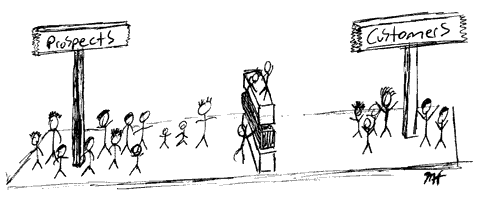
How many hurdles do your customers have to jump over before they can give you their money?
A lot of small businesses don’t understand that the buying process itself is a crucial part of their marketing. If you bombard people with countless questions and make it difficult for them to order, chances are they’ll be quite annoyed before they even start working with you. That annoyance will be directly counted against your brand, and whatever good will it currently has.
Conversely, if you have a simple ordering process, people will remember that you made it easy on them. Your customers will have a good feeling towards you from the beginning. And guess what, they’ll share that with others.
All of your marketing materials are designed to help customers over the buying-hurdle. The easier it is to buy from you (the smaller your buying-hurdle), the more effective your marketing materials will be, and the more new customers you’ll get.
Streamlining your ordering process could significantly speed up the success of your small business. Here are 7 ways to make your business easy to buy from.
Keep your products well organized
Whether online or brick-and-mortar, you need to make finding products intuitive. This means placing related products together, arranging things in a logical order (if they have one), categorizing products using common language, and using obvious signs or links to help people find what they want. If a customer can easily find his way around (online or in store), then he or she is much more likely to buy.Clearly mark the next step
When people are confused, they are much more likely to leave. You want to avoid any confusion by making the next step(s) clear and easy to see. If they are on a product page, you probably want a clearly marked “Buy Now” button. If they’re filling in a form, make sure the submit button is large and easy to see. People are much happier when things are clear and well organized.Use contextual information
You want to have enough information so your customers aren’t confused, but not enough that they are overloaded. The key to doing this is to place information contextually. This means, essentially, putting information in the right place. Instead of having a single FAQ page, try putting important FAQs on the page that they pertain to. Make sure you put explanations near anything that might be confusing. You want to put information where it is useful, and not anywhere else. If you cut out the extras and leave the only essential information, your customers will thank you.Use big fonts and lots of whitespace
Make sure everything doesn’t all blur together. Use big fonts so that everyone can easily read what you have to say. Also, you can use whitespace to divided different sections and make them easier to distinguish. The end goal is to have everything presented as clearly as possible. Good presentation will make your small business appear more professional, too.Only ask your customers the essentials
Every single thing you ask your customer will take them time to think about, and time to answer. Do your best to respect their time by not asking for anything that doesn’t have a very specific purpose or value to you. Asking for their name, phone, and email is good; asking for three phone numbers is bad. The buying process is not the place for redundancy.If you have a lot you need them to do, break it up
Chances are you probably don’t need customers to give you all of their information up front—so if you can save some questions for after they buy, it will make their initial experience a lot more pleasant. Once they are a customer, they will be committed to working with you, and you can spread their tasks out over time.Keep them interested the whole time they are buying
A lot of websites have a very friendly tone on their sales pages but adopt a formal voice on ordering pages. It is a big mistake to assume a person will buy as soon as they get to the order page; you need to keep marketing, and keep them interested, the entire time they are buying. This goes for the brick-and-mortar world as well. You don’t want people to walk out of your restaurant because your wait staff wasn’t friendly enough.
In the end, it all comes down to making the buying process as intuitive and easy as possible. The lower you make your buying hurdle, the more people will jump over it. Also, the better their experience buying from you, the more likely they are to come back for repeat business.
If you liked this article, why not subscribe? You’ve got nothing to lose.




Reader Comments
I work for an e-commerce site, and I keep telling our marketing manager these tips, and he continually doesn’t do it. It’s sad. I’ll forward him this.
I especially agree with the 2nd tip - to “Clearly mark the next step.” I’m sure that many of us, myself included, thought that we had completed an order or scheduled a payment when there was really a “Confirm” button or another entire step that was missed. It is an extremely frustrating issue as a customer, and there’s little chance of the customer re-filling the previous steps at a later time.
I personally have been trying to research better sales techniques for my sales pages. I need to find a balance for my sales pages so that I do not seem to pushy. I want people to hit the Buy Now button. I do not want them to feel forced into it, because that might push the customer away.
number 5 is a really big conversion killer. Many ecommerce sites ask for a lot of personal details, most of them not needed for the actual buying, but for other statistics. this is useless, in my opinion. why lose a sale, just because you want to know the user’s age or other details? First you make the sale and then you send them all a quick survey
why use big fonts? Amazon doesn’t use them and I think they are pretty successful. You’ll stress the user with huge fonts
I think nr 2 is very important. I visited a lot of websites which had the checkout process so strange, that sometimes I didn’t even know what I should do next. the submit buttons were so small and were blending so well in the design, you could hardly notice them
Awesome! Everything I desired summarised in a very short way. In my opinion,it’s the most amazing work I have ever read.
I really enjoyed this brilliant blog. Please keep them coming. Greets !This is a in fact good read for me, Must admit that you are human being of the best bloggers I ever saw. Thanks for posting this informative article.
The faster the buying process is the faster the buying will be. rt57hgy6 What determined your final assertions? Who else respectfully shares your sentiment in relation to this matter? Patiently awaiting a speedy reply.
I think positioning is the first and most crucial step of the buyer-seller process. Nothing will greater determine the desired outcome more than how the product/service is perceived by the consumer. Chisel out a unique, untapped groove in the from the larger market and your barrier to success is almost non-existent.
Labor can win the upcoming election and they know it, they just have to for we electors have known for a long time. <a >mulberry bags outlet uk</a>
<a >mulberry mitzy bags</a> Add-ons: Victor #5 Victrola With Oak Horn; Victor #6 Victrola with No Horn; Walnut Ribbon Cabinet; Collection of lamps to include Steel Hanging Fixture w/ Handel Shades; Classique 18” Yellow Poppy Table Light fixture; Gone With the Blowing wind Floral Painted Lights; 16” Pairpoint Floral Hummingbird Table Light fixture; Gilt Etched Cranberry Food Lamp w/ Cut Planet; 8” Cut Glass Boudoir Lamp; Selection of Tiny Oil and Peg Lights w/ Globes; Satin Gone w/ the Wind Light fixture; Tall Hammered Copper Lamp Base. <a >thomas sabo uk 2013</a>
Its most memorable scene is of sex-obsessed Dorien, played by Lesley Joseph, exaggerated erotic karaoke performance to Madonna’s Like a Virgin.. She did the Southern Tier the year before me and I read her blog every day in preparation for my own trip. <a >louboutin outlet</a>
<a >change windows 7 product key</a> doll.
some great tips here, I appreciate having these looked at because my current situation desires it.
good tips, appreciate the input.
This has been a very enjoyable write-up. I really look forward to more of your articles. Please share them soon. I hope you keep this up
I want to lower my buying hurdle. i want to follow your tips for this.
I am also a small business holder. I want to imply this.
If you had the chance, what would you change about it? either way, i find this post very interesting. I hope that you would post more like it. keep up the good work
i am going to establish a small business. i need to know these facts.
Add Your Comment